
Better Questions, Better Answers: Interrogating AI & Digital Healthcare

As a consumer of and a provider of healthcare, I find the rapid evolution of digital healthcare technology exciting but also challenging.
Consider a patient who has undergone total knee replacement surgery searching online or asking an AI chatbot for more information regarding exercises to perform during the first few weeks after surgery. The query produces a list of exercises including isometric quadriceps contractions. But the query does not explain why the exercises matter, what they are intended to accomplish, or how they are related to the individual’s expectations.
Intervening without knowing why, without purpose, is likely risky and potentially wasteful.

Climbing the wrong ladder misses the target
There is a more useful question to ask. Why am I being told to do this exercise, and how might it help me do what matters to me?
Using an AI chatbot or digital health tool begins with a question from a human. The question is most likely what to do for the symptom or diagnosis.
Valuable information is gained from asking what. However, author Simon Sinek in his book “Start with Why” posits before seeking answers to what look to answer “why.” Why gets to the purpose. Once the purpose (the why) is determined, the strategy (the how) and the execution and tactics (the what) become significantly easier, more accurate, and focused. He contends that asking a why question first results in understanding the purpose, root cause, or ultimate goal before wasting time, energy, and resources on the wrong solutions.
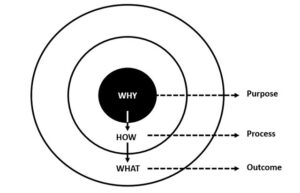
Simon Sinek's Golden Circle Framework
The Golden Circle Framework was developed primarily to explain purpose and motivation in organizational leadership, not to establish clinical effectiveness. However, the framework aligns with clinical principles of patient-centered communication and motivational interviewing techniques, which have been shown to improve outcomes in chronic pain syndromes. [1], [2]
An example of an initial query with a question using diagnosis is what exercises should I focus on during the first 3 weeks after my total knee replacement?” The query will result in a list of exercises. One of the exercises is Isometric quadriceps contractions.
A follow-up query to the AI chatbot asking a “why” question is as follows. Why is it important that I do isometric quadriceps contractions after my total knee replacement?
The AI chatbot might answer: Isometric quadriceps sets will overcome neural inhibition, rebuild strength, and improve knee straightening.
The default answer a healthcare clinician provides when faced with the question of why regarding an intervention is typically a reason based on biology, physiology, and biomechanics. Biological reasons have some importance for patients. However, when dealing with musculoskeletal pain syndrome, the reason or the purpose of an intervention is usually to reduce pain, improve function, and improve quality of life.
Understanding why an intervention is recommended may help patients participate more actively in their care, especially when its purpose aligns with their goals and expectations.
A more meaningful query than why this exercise is important is to provide contextual details related to pain and function.
Expectations regarding pain:
For example, how will isometric quadriceps contractions after my total knee replacement affect my pain?
AI chatbot might answer: Clinical research shows that early, targeted isometric quadriceps exercises significantly decrease post-surgical pain intensity compared to standard or delayed recovery protocols. [1]
Expectations regarding function & abilities:
For example, how will isometric quadriceps contractions after my total knee replacement help me to be able to play with my grandchild?
AI chatbot might answer: Playing on the floor or getting up from a tiny chair requires a strong burst of front-thigh power. Early isometric work lays the foundation for moving into squats, step-ups, and rising from a couch with confidence. [3]
Potential advantage of using an AI Chatbot.
Asking why and seeking the purpose behind a recommendation can support better decisions and outcomes. In conversations between healthcare providers and patients. However, “why” questions may sound confrontational or make someone feel compelled to justify their choices. AI chatbots offer a useful alternative. You can explore the purpose behind a recommendation, ask repeated follow-up interrogating questions, and refine your understanding without worrying that the AI chatbot will feel criticized or offended.
However, the argument needs one important qualification: a chatbot's willingness to answer repeated questions does not guarantee the accuracy of its answers.
An AI chatbot can be a useful place to explore questions you might hesitate to ask in a clinical encounter. But the convenience of getting an explanation should not be confused with its reliability. Fact-check and verify medical claims and discuss treatment decisions with your healthcare professional.
Remote Physical Therapy Monitoring
A burgeoning form of digital healthcare is remote physical therapy monitoring platforms that use software, apps, and computer vision to instruct exercises and track progress outside the clinic. Not all platforms offer access to a licensed physical therapist; some are clinician-backed, others AI-backed. Some remote physical therapy exercise monitoring platforms explain each exercise’s purpose the “why.” On others, explanations depend on the provider or AI chatbot designing and personalizing the program. An exercise demonstration is not the same as an explanation of its purpose, and neither guarantees that the exercise is appropriate for a particular patient.
Connect the information to your purpose
Digital health technology and AI chatbots can tell you what to do. The more important question is whether it can help you understand why you're doing it. Whether guidance comes from a clinician, a chatbot, or a digital rehabilitation platform, the most useful recommendation is not simply the one that explains an exercise. It is the one that connects that exercise to your own expectations.
I keep six honest serving men. They taught me all I knew. Their names are why, how, what, when where, who.
Rydyard Kipling
References:
- Alperstein D, Sharpe L. The Efficacy of Motivational Interviewing in Adults With Chronic Pain: A Meta-Analysis and Systematic Review. J Pain 2016;17(4):393–403 doi: 10.1016/j.jpain.2015.10.021 [published Online First: 20151127].
- Kasimis K, Apostolou T, Kallistratos I, Lytras D, Iakovidis P. Effects of Manual Therapy Plus Pain Neuroscience Education with Integrated Motivational Interviewing in Individuals with Chronic Non-Specific Low Back Pain: A Randomized Clinical Trial Study. Medicina (Kaunas) 2024;60(4) doi: 10.3390/medicina60040556 [published Online First: 20240329].
- Kondo Y, Yoshida Y, Iioka T, et al. Short-Term Effects of Isometric Quadriceps Muscle Exercise with Auditory and Visual Feedback on Pain, Physical Function, and Performance after Total Knee Arthroplasty: A Randomized Controlled Trial. The Journal of Knee Surgery 2022;35(8):922–31 doi: 10.1055/s-0040-1721035 [published Online First: 20201125].
The information on this website is not intended or implied to be a substitute for professional medical advice, diagnosis, or treatment. You are encouraged to perform additional research regarding any information available through this website, with other sources, and consult with your physician