
Hip-Spine vs Spine-Hip vs Both – 3 Case Examples Lessons Learned
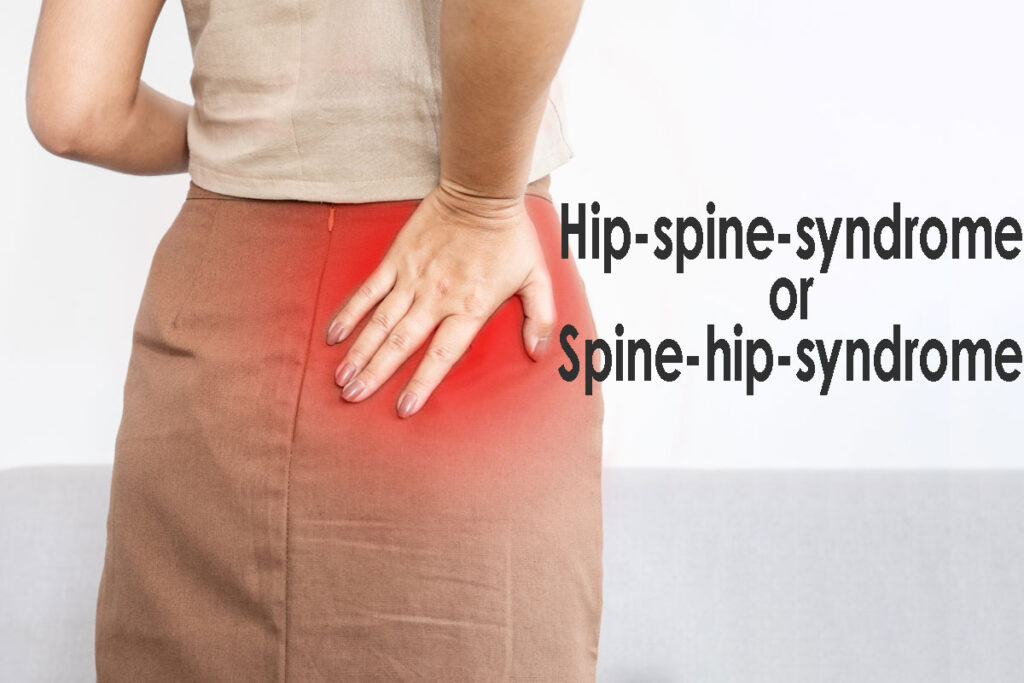
An 80-year-young woman visited her primary care physician with “pain going down my leg”. She had difficulty grocery shopping, picking up her small dog. X-rays showed osteoarthritis in her lumbar spine, and she was diagnosed with “sciatica.” The doctor referred her to a spine surgeon, who ordered an MRI and gave her an x-ray-guided spinal injection. When this did not relieve her symptoms, she was then referred to Physical Therapy before considering another injection. On examination, I could not reproduce her “pain going down the leg” through spinal movement but did find it could be provoked by moving her hip and knee, without moving the spine. This pointed to the pain originating from the hip, not the spine.
This is an example of hip-spine syndrome, a condition in which problems with both the hip and the spine overlap, making diagnosis and treatment challenging. Hip-spine syndrome is classified as follows: 1, 2
- Simple: only one joint (hip or spine) causes symptoms, though both may show structural deviations.
- Complex: both hip and spine issues contribute to pain with no clear primary source.
- Secondary: one joint’s problem has caused or contributed to the other’s pathology, and both are symptomatic.
- Misdiagnosed: The main source of pain is incorrectly identified, leading to ineffective treatment.
A patient’s classification can change over time as their symptoms and underlying issues evolve.
In simple hip-spine syndrome, the hip is the main source of the pain, with the spine incidentally involved. In simple spine-hip syndrome, the spine is the primary source, with the incidental hip involvement.
Physical Therapy should be part of the treatment for all forms of hip-spine or spine-hip syndrome. Therapy must be sustained for a sufficient duration 3 before considering irreversible interventions unless there are red flags or signs of neurological deficits. Therapy should target both the hip and the spine, even if one area is not painful, as addressing subclinical issues may prevent future complications. Customized therapy is essential because controlled clinical trials in this area are limited, and making high-quality evidence scarce. 4
A complex example is a 50-year-young woman with years of left buttock and hip pain, imaging evidence of hip labral tear and gluteus medius tendinopathy, and a pinched spinal nerve. This ongoing case led me to further explore and write about hip-spine syndrome. Key lessons learned from this case:
- There is no current orthopedic subspeciality for hip-spine syndrome or for spine-hip syndrome, so an optimal approach involves a team: an orthopedic surgeon who specializes in hip and an orthopedic surgeon or neurosurgeon who specializes in spine, and a Physical Therapist.
- Advocate for effective communication among the care team, ideally through joint consultations for major decisions.
- Remain aware of each specialist’s potential biases in team decision-making.
A case of secondary hip-spine syndrome involves a 70 year-young man with rheumatoid arthritis of the hip, milder sacroiliac disease, and thoracolumbar osteoarthritis. Multiple blind steroid injections (given without imaging guidance) led to permanent hip muscle weakness. Although his hip pain improved after a hip replacement, the weakness now stresses his spine, causing daily back pain. Lesson learned: Whenever diagnostic injections are needed to localize symptoms, imaging-guided injections are preferred for accuracy and to avoid harm. 5
The previously described 80 year-young woman represents a misdiagnosed spine-hip syndrome. The common reframe from the older spiritual song “dem bones” is the “hip bone is connected to the backbone” is relevant. Lessons learned from this case include:
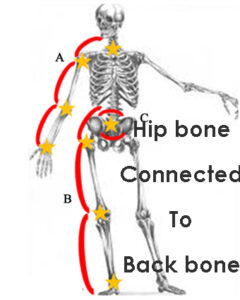
Hip Bone Connected to Back Bone
- Patients often prefer a specific diagnosis, but vague terms like “leg pain” can help avoid premature or inappropriate treatment. 6
- Do not automatically assume that imaging findings explain the pain. Corroborate with history and physical examination.
- Distinguish the hip from spine pain with careful physical tests.
- Seek consultation with a Physical Therapist if pain in one area occurs or co-exists with pain in the adjacent area.
- Expect uncertainty – find a provider who displays intellectual humility and is willing to navigate diagnostic complexity.
- Aim to prevent cases from progressing from simple to complex or secondary.
Pain in your leg may come from your hip, spine, or both, and Physical Therapy can help figure it out.
These case examples demonstrate that hip-spine or spine-hip syndrome is a complex, interrelated issue necessitating more collaborative care, often posing more questions than answers.

More Questions Then Answers
References:
- Offierski CM, MacNab I. Hip-spine syndrome. Spine (Phila Pa 1976). 1983;8(3):316-321.
- Prather H, van Dillen L. Links between the Hip and the Lumbar Spine (Hip Spine Syndrome) as they Relate to Clinical Decision Making for Patients with Lumbopelvic Pain. PM R. 2019;11 Suppl 1(Suppl 1):S64-S72.
- Harris-Hayes M, Steger-May K, A MB, Mueller MJ, Clohisy JC, Fitzgerald GK. One-year outcomes following physical therapist-led intervention for chronic hip-related groin pain: Ancillary analysis of a pilot multicenter randomized clinical trial. J Orthop Res. 2021;39(11):2409-2418.
- Ceballos-Laita L, Estebanez-de-Miguel E, Jimenez-Rejano JJ, Bueno-Gracia E, Jimenez-Del-Barrio S. The effectiveness of hip interventions in patients with low-back pain: A systematic review and meta-analysis. Braz J Phys Ther. 2023;27(2):100502.
- Foxcroft B, Stephens G, Woodhead T, Ayre C. What factors influence pain scores following Corticosteroid injection in patients with Greater Trochanteric Pain Syndrome? A systematic review. BMC Musculoskelet Disord. 2024;25(1):149.
- Martin S, Smith M, Wilson DA, Zadro JR, Ferreira GE, O'Keeffe M. Non-specific diagnostic labels for musculoskeletal conditions foster positive views about prognosis and non-invasive management but require clear explanation: a systematic review. J Physiother. 2025;71(3):167-178.
The information on this website is not intended or implied to be a substitute for professional medical advice, diagnosis, or treatment. You are encouraged to perform additional research regarding any information contained available through this website with other sources and consult with your physician