Pain Severity vs Pain Irritability: Why the difference matters in musculoskeletal care
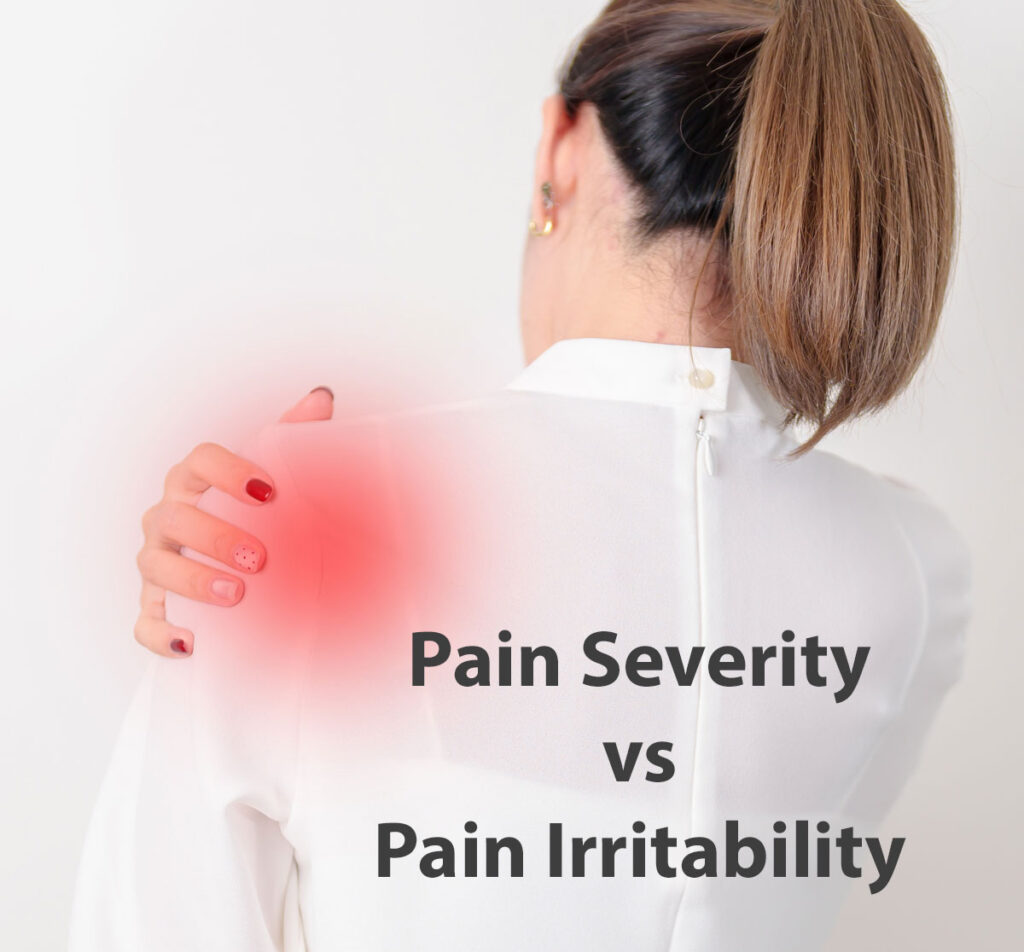
A recent patient with shoulder pain persuaded me that pain intensity does not always reflect the clinical seriousness of a condition. Pain irritability – how easily pain is triggered and how long it lasts – often matters more for guiding treatment decisions.
A 65-year-old male reported right shoulder pain. When queried, when did it start – 4 months ago. He reported the intensity of shoulder pain varied between zero to 3 out of 10. When I queried what made it worse, it was swimming freestyle, particularly when breathing on the left side. When queried what made it better, he reported I cut my distance swimming by one-third, avoided breathing on the left side, switched from 6 days a week to 3 days a week, started using flippers, and over-the-counter pain medication to help sleeping. His pseudonym is MR Stoic.
Curiously, I asked why did you wait so long to ask for assistance; his response was” the intensity never got worse than mild.”
This is an example illustrating the difference between the severity or intensity of pain and the level of irritability of pain. The severity of pain did not worsen, but the level of irritability did.
Strategies to manage musculoskeletal pain often focus on pain severity – how intense the pain feels. Yet another useful concept is pain irritability, which describes how it is to cause pain and how long it takes to settle the pain.
Severity of pain is like the loudness of a car alarm, whereas the irritability is how easy or difficult it is to trigger the car alarm.
Severity and irritability often overlap and manifest similarly. However, recognizing the distinction between severity and irritability can provide nuanced guidance for the healthcare professional and/or the Do-It-Yourself individual in the management of painful musculoskeletal pain syndromes.
Though important, irritability remains harder to assess and standardize than severity. Clarifying the concept of irritability of pain symptoms can help determine whether to progress activity levels conservatively or aggressively.
Measurement of Irritability:
Evan Petersen & colleagues have proposed an irritability classification. The criteria include quantifying the amount of aggravating activity relative to easing activity; time before symptoms appear; time symptom ease; pain at rest; and effect of symptoms on sleep.
| Irritability Level | Characteristics | Activity-Easing Ratio | Pain at rest | Sleep impact |
| Low or Mild Irritability | Requires high effort to provoke pain and ease quickly.
Can perform the activity for a long time before symptoms appear. |
Ratio of 2:1 - of aggravating activity relative to easing activity
Greater amount of aggravating activity & little easing activity. |
No pain at rest | No Impact |
| Moderate Irritability | When symptoms appear may ease quickly by stopping to ease activity or resting.
Time to provoke pain is similar to time to recover from pain. |
Ratio of 1:1 - of a small amount of activity requiring disproportionately more recovery time. | Intermittent pain at rest | Symptoms interrupt sleep, but can return to sleep in < 30 minutes |
| High or Severe Irritability | Symptoms are easily provoked and take a long time to ease.
Time to provoke pain is short relative to the time to recover from pain. |
Ratio of 1:2 - of a little amount of aggravating activity requires a lot of easing activity. | Pain at rest | Sleep is interrupted frequently, and prolonged requires > 30 minutes to return to sleep.
Requires medication to sleep |
Mr. Stoic provides an example of progressively increasing the easing activity to keep the severity of pain at a low level.
How to manage a high level of irritability:
Monitoring the irritability of pain symptoms in combination with the severity of pain symptoms provides an opportunity to develop a paradigm for clinical reasoning that enables patients and clinicians to more accurately tailor treatment strategies for painful musculoskeletal syndromes.
When severity and irritability are aligned (both high or both low), treatment decisions are straightforward. When they diverge, clinical reasoning becomes more complex and nuanced.
Four Square Quadrant Relationship of Severity & Irritability
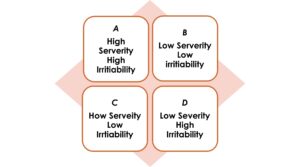
High level of severity & high level of irritability – Quadrant A
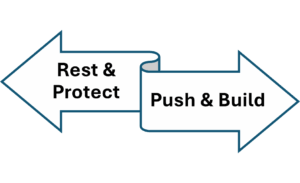
- Activity exercise should encompass a “resting & protecting” approach.
- You should not attempt a Do-It-Yourself” approach.
- Seek assistance from health care professionals.
Low level of severity & low level of irritability – Quadrant B
- Activity exercise should encompass a “push & build.”
- You can safely manage this with a Do-it-yourself approach.
High level of severity and low level of irritability – Quadrant C
- Decisions regarding adjustment of activity exercise are on a spectrum between requiring a balance between conservative rest and protection and aggressive pushing and building approach. The bias can be towards the more aggressive push and build approach.
- A Do-it-yourself approach may benefit from guidance from healthcare professionals.
Low level of severity & high level of irritability – Quadrant D
- Decisions regarding adjustment of activity exercise are on a spectrum between requiring a balance between conservative rest and protection and an aggressive pushing and building approach. The bias can be towards the more conservative rest and protect approach.
- If you are the patient, you may benefit from seeking guidance from a healthcare professional before attempting a do-it-yourself approach.
- If you are a healthcare professional, schedule more frequent monitoring and utilize frequent telehealth monitoring.
- Include more frequent, longer recovery periods.
- Look for informationon how to alter pain sensitivity – pain neuroscience education.
- Reflect on the full spectrum of factors that can contribute to a high level of irritability, including emotions, stress level, hormone changes, central sensitization, chronic information, sleep disturbances, nutritional deficiencies, and others.

Mr. Stoic’s “swimmer’s shoulder progressed from Quadrant B - low severity, low irritability to Quadrant D – low severity, high irritability. He decided to progress from Do-It-Yourself and sought my Physical Therapy consultation. The plan of care includes rest and protection, altering the activity exercise volume by abstaining from swimming for a period of time to allow appropriate healing of the shoulder tendon; focused isometric strengthening exercises for the rotator cuff, starting at mid-range, progressing to end range.
Mr. Stoic returned to swimming; he used YouTube University to identify more optimal swimming form mechanics to alter deviant movements, particularly when he breaths on his right side.
Mr. Stoic is now swimming with low severity of pain 6 days a week. On the days that he swims 2500 meters, the pain symptoms resolve before the next morning.
Mr. Stoic’s irritability decreased; he could tolerate longer swimming distances with faster symptom resolution — progression became appropriate. He is now Quadrant B - low severity – low irritability.
Failing to recognize situations where there is low severity of pain and high irritability has a risk of underestimating the painful musculoskeletal problem.
The information on this website is not intended or implied to be a substitute for professional medical advice, diagnosis, or treatment. You are encouraged to perform additional research regarding any information available through this website, with other sources, and consult with your physician