How Horizontal Body Proportions “Inverted Triangle” Can Relate to Back Pain
A current patient with recalcitrant back pain is challenging me to look for innovative strategies for treatment.
This 29-year-old male has a 3-year history of low back pain. The pain occurs daily, with an average intensity of 3 out of 10. The symptoms are worse with prolonged sitting. Worse on days that he is more physically active. Diagnostic imaging showed that he has mild degenerative disc disease at multiple levels.
He reports that the results of previous interventions, including Physical Therapy, blind steroid injections, and radio-frequency ablation, are less than satisfactory.
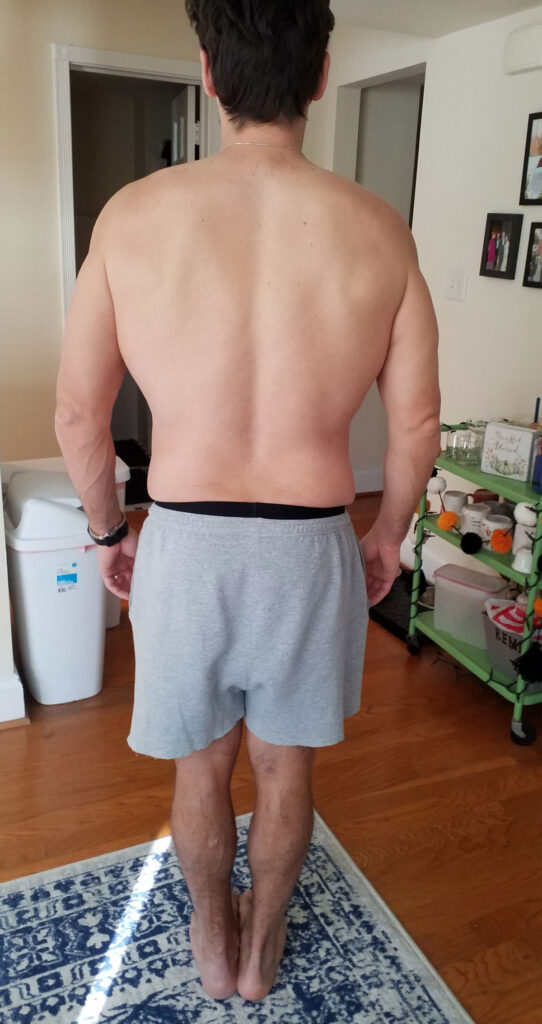
I observed that his posture shows disproportion in vertical height.
Most of his height is in his torso, and his legs are relatively short. His stature does not match Di Vinci’s “Vitruvian Man.” He is a standard deviation from the Vitruvian Man.
In a previous blog post, I posited a working hypothesis that disproportionate stature in vertical height can be a risk factor for musculoskeletal pain syndromes. Generally, a long torso and relatively short legs are more prone to back and neck problems. Whereas short torso and long legs are more prone to hip and knee problems.
This case suggests that horizontal disproportion in body stature may increase the risk of musculoskeletal pain.”
Wide Torso - Narrow Pelvis
Notice in the photo that the width of his upper torso is relatively wide, and the width of the pelvis is relatively narrow. In addition to the shape, notice the large muscle mass of the shoulders and upper back versus the relatively small muscle mass around the buttocks and pelvis. He exercises on a regular basis, including cardio and weightlifting. Weight-lifting 3 to 5 days a week. One day a week is weightlifting for legs, while the other days are chest and back weightlifting.
Experts in fashion clothing describe this body type as an inverted triangle, or upside-down pyramid.
Mechanically, an upside-down pyramid is inherently unstable because its weight is concentrated at a tiny point, lacking a broad base for balance, making it inherently unstable.
We can counteract this form-fault by adding internal and external structural support that more evenly distributes forces.
Tactics to enhance internal compensation:
Alter and rebalance his weightlifting routine. Reduce the volume of weightlifting for the back, chest, and arms. Increase the volume of weightlifting for the pelvis and leg muscles. Focus on lumbopelvic control, endurance, and symmetry.
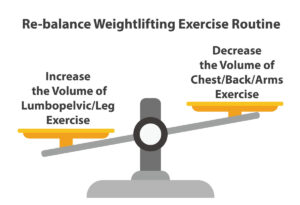
Scale balancing exercise for lumbopelvic/leg vs exercise for chest/back/arm
The working hypothesis is that if he decreases the higher center of muscle mass in the chest and upper back, then more optimal lumbar joint reaction forces. If he reduces the concentration of muscle mass in his chest and upper back, his lumbar joints should experience more optimal reaction forces.
Tactics to enhance external compensation:
Use a weightlifting belt, and/or high waist compression shorts. For ladies, using a body shaper garment, or in historical terminology, a foundation garment. This should help distribute forces and reduce adverse forces in low back region.
Use a contoured seat cushion with side flanges or a buttress, or select chairs that have a contoured seat pan. Such a cushion supports the pelvis and buttresses the upside-down pyramid body type.

When sitting, look for ways to utilize arm support. Minimize or avoid sitting on benches and chairs without arm support. Sitting on the couch, stay close to arm rest and use throw pillows for armrests. Adjust the computer chair to utilize armrests. Make sure feet are on the round or footstool, rather than the rung of the chair. This can improve load sharing distribution and the capacity to sit for longer periods without back pain.
Form Follows Function:
This case demonstrates the core scientific and design principle that form determines function.

Pain is a functional symptom. This individual’s form/structure or morphology of an inverted triangle body type has an intertwined relationship with his pain.
Although we can’t easily change an individual’s body type, we can compensate for its limitations with internal and external support that more evenly distributes forces, enhancing function.
Because this case has a long 3-year history, my expectation is that results supporting or refuting the working hypothesis will not occur quickly.
The information on this website is not intended or implied to be a substitute for professional medical advice, diagnosis, or treatment. You are encouraged to perform additional research regarding any information available through this website, with other sources, and consult with your physician